
Ransomware is no longer a threat confined to large enterprises. Today, an attack is estimated to occur every 11 seconds worldwide, and nearly 63 percent of businesses were affected by ransomware attacks in 2025. The financial impact is also rising sharply, with global damages expected to hit $74 billion in 2026. Ransomware continues to rank as the leading cyber risk year after year, with organizations identifying it as a top concern.

Essential Ransomware Response Plan checklist for businesses
The rise in attacks has left businesses of all sizes with no choice but to adopt a structured approach—not only to contain ransomware incidents but also to implement proactive measures that limit their impact. A practical framework that supports teams through every stage, from early detection to complete recovery.
Why every business needs a ransomware response plan
Most IT teams understand the importance of having a ransomware response plan. However, far fewer have one that performs effectively under real-world pressure. Here’s why formalizing one is non-negotiable:
- Increasing frequency of attacks: Cybercriminals’ tactics are constantly evolving, leading to more frequent ransomware incidents across industry verticals.
- Downtime prevention: A response plan should ensure that the organization can act promptly, reducing operational downtime and financial damage.
- Stricter compliance mandates: Governments and regulatory bodies are enforcing stricter data security and incident reporting requirements. A response plan helps ensure compliance and shared accountability among stakeholders.
- Public trust and reputation preservation: Effective responses to ransomware incidents help organizations preserve customer trust and protect their business reputations, even in the event of a breach.
Before defining operational steps, organizations should establish core principles that guide their response strategy.
- Clearly defined roles and responsibilities
Each team member must understand their role before an incident occurs. Clarity eliminates confusion, prevents duplication of effort, and ensures that no critical step is missed. - Fast recovery as the primary objective
An effective plan prioritizes minimizing recovery time. The faster systems are restored, the lower the financial and operational impact. - Data integrity at the core
Reliable, secure backups are the backbone of recovery. Organizations should maintain at least one offline backup and regularly test restoration processes to ensure reliability. - Continuous improvement
Every incident provides valuable insights. Teams should treat the response plan as a living document, refining it based on post-incident analysis and evolving threat intelligence.
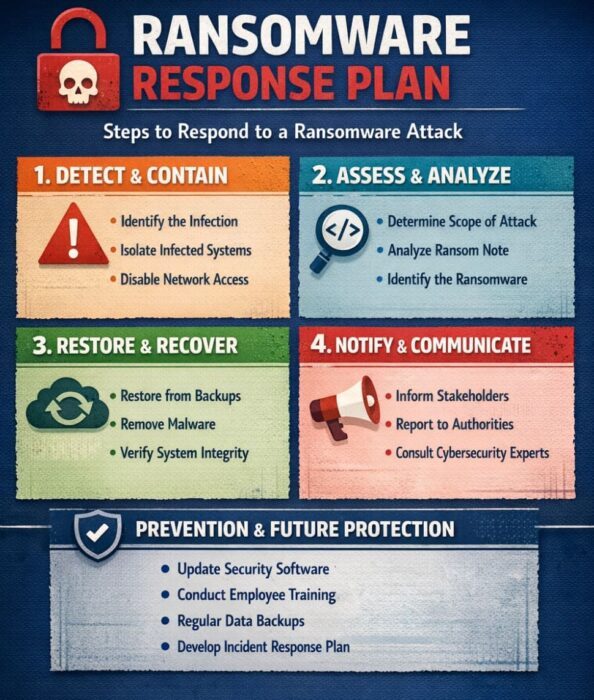
Here are the five operational stages of a ransomware response plan
Stage 1: Prevention
Prevention remains the most cost-effective defense. Organizations should combine technical controls with user awareness to reduce risk.
- Access control and network segmentation: Limit user privileges and segment networks to prevent lateral movement.
- Patch management: Address vulnerabilities quickly, ideally within 24 hours of critical updates.
- User education: Since most ransomware attacks originate from phishing emails, regular training is essential.
Stage 2: Detection
Early detection significantly reduces the impact of an attack. The faster a threat is identified, the less damage it causes. Effective detection strategies include:
- Continuous network monitoring through intrusion detection systems
- AI-driven behavioral analysis to flag suspicious activity
- Next-generation antivirus (NGAV) solutions that detect unknown threats based on behavior rather than signatures
Stage 3: Communication
Ransomware incidents affect the entire business, not just IT. Poor communication can escalate the situation quickly. A strong plan should define:
- Clear communication channels to avoid delays
- Escalation procedures for notifying key stakeholders, including IT leaders, legal teams, executives, and affected customers
- Messaging protocols: Predefined templates to ensure consistent and accurate communication
Stage 4: Containment and eradication
Once detected, the priority shifts to limiting damage and eliminating the threat. Key actions include:
- Isolating infected systems to prevent lateral movement
- Quarantining compromised devices and disabling network access
- Removing all traces of ransomware from infected systems
- Resetting credentials and patching exploited vulnerabilities
- Isolating infected systems to prevent lateral movement and additional network infection.
- Quarantine any compromised devices and disable network access in impacted systems.
- Removing every bit of ransomware from infected systems.
- Resetting passwords and fixing the vulnerabilities that were exploited in the attack.
Stage 5: Recovery and post-incident review
Recovery depends heavily on the quality of backup systems. Organizations should restore data from verified backups and validate system integrity before reconnecting to the network.
Equally important is the post-incident review. A structured, blameless analysis helps teams:
- Identify root causes
- Evaluate response effectiveness
- Improve future preparedness
Regular simulation exercises further strengthen readiness.
How ManageEngine Ransomware Protection Plus supports your response plan
A well-documented plan is essential, but pairing it with purpose-built tooling significantly improves the speed and effectiveness of each stage. ManageEngine Ransomware Protection Plus is an ML-based endpoint security solution designed to address ransomware across the full attack lifecycle, from pre-attack detection to post-attack recovery.
ManageEngine Ransomware Protection Plus offers a 30-day free trial for unlimited endpoints, providing a practical entry point for strengthening ransomware defences.

Leave a Reply