
The internet is flooded with new AI tools, but only a few truly stand out. Among them, one such tool is FlowithOS. It is a desktop-based AI agent operating system built for Windows and Mac, designed for real-world workflows. If you haven’t heard of the tool before, this post will share a complete FlowithOS review so you can learn everything about it.
What is FlowithOS?
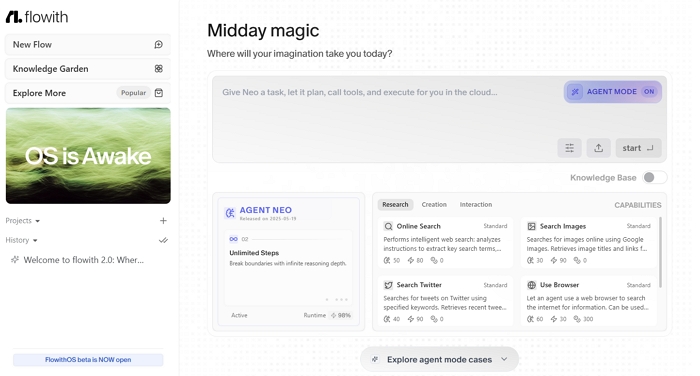
FlowithOS is an AI-agent operating system created for one purpose — to make AI agents smarter, faster, and self-aware. The tool is based on three core principles: self-improvement, advanced memory, and optimized speed. It uses all these to create a system where AI doesn’t just execute commands but evolves with every interaction. You can consider it an OS within an OS.
Most AI tools operate in isolation, handling one task at a time. However, FlowithOS manages the memory, computation, and communication of AI agents.
It also has a self-improvement architecture that helps agents learn from user behavior. It offers an advanced memory management system for handling larger contexts.
Additionally, it provides optimized performance. With dependency-aware scheduling algorithms and priority-based resource allocation, it achieves up to 2.1× faster execution speeds in complex multi-agent environments. The system anticipates task dependencies, reorders workloads for optimal efficiency, and dynamically balances CPU and GPU utilization in real-time.
Key Features of FlowithOS
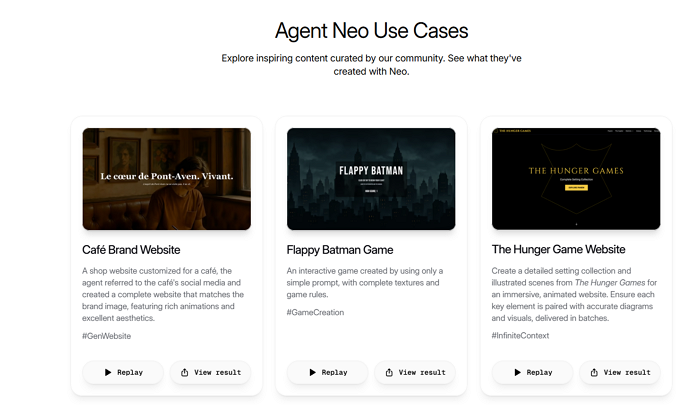
1] Self-improvement architecture
As mentioned earlier, FlowithOS is designed around a self-improvement architecture. This means the AI learns as you interact with it. Through continuous learning, agents collect insights from user behavior, task outcomes, and execution data, refining their reasoning and workflows over time.
Furthermore, the OS also has predictive intelligence. As a result, it proactively manages computer resources, anticipating workload patterns and adjusting CPU and memory allocation dynamically. Feedback loops also capture real-time performance data and user corrections, enabling agents to progressively enhance their understanding of both context and intent.
2] Advanced memory management system
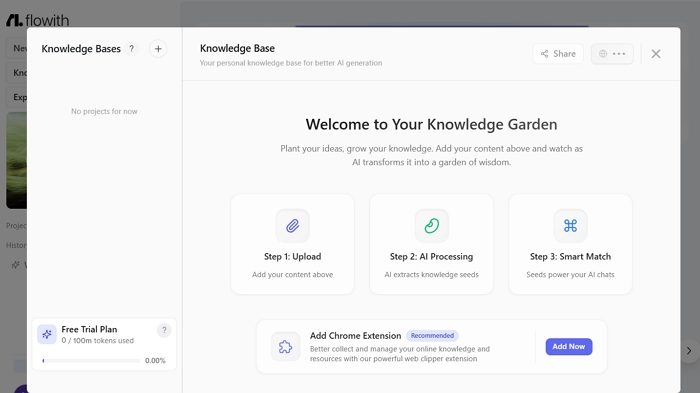
MemoryOS concepts inspire this feature, and FlowithOS implements a three-tier hierarchical memory architecture that mimics how human memory organizes information. It stores information in three ways:
- Short-term memory: Manages immediate context and recent inputs, ensuring that ongoing interactions remain coherent.
- Mid-term memory: Stores session-based data with a dialogue-chain FIFO (First-In, First-Out) logic, allowing structured retrieval and continuity between related tasks.
- Long-term memory: Holds persistent knowledge using a segmented page organization strategy, preserving critical information across sessions and agent lifecycles.
The system performs dynamic updates between these memory tiers, automatically promoting or demoting information based on relevance. Furthermore, context management techniques like compression, summarization, and tagging maintain efficiency while ensuring that agents retain essential knowledge.
3] Performance and speed optimization

FlowithOS achieves up to 2.1× faster execution in agent operations through advanced scheduling and optimization algorithms. The tool smartly prioritizes workloads using dependency-aware resource allocation and ensures that interconnected tasks are executed in an optimal sequence.
Furthermore, the OS also analyzes dependencies between agent requests, reorganizes execution queues to minimize idle time, and maximizes throughput. Its priority and urgency-based optimization model ensures critical tasks receive immediate processing power without compromising overall system stability.
4] Core operating system services
FlowithOS also offers a full suite of core system services. It features multiple functionalities, including scheduling that efficiently manages multiple agents and concurrent tasks.
Its context management feature maintains the flow and state of conversations across sessions. Its memory management organizes, retrieves, and synchronizes agent knowledge.
Furthermore, you can use access control to manage agent permissions and data security. You can also integrate it with external APIs, applications, and datasets for enhanced functionality.
5] Agent SDK and Development Tools
FlowithOS also offers a comprehensive Agent SDK. So if you are a developer, you can access all its capabilities. The SDK supports multi-step reasoning, tool-calling, and memory editing, allowing agents to interact intelligently with both data and external systems.
Plus, using the SDK, you can design custom agents, manage their lifecycle, and extend system functionalities via APIs. This allows you to build adaptive workflows, integrate specialized domain knowledge, and deploy agents capable of real-time learning and collaboration.
6] Multi-agent Collaboration
FlowithOS is built for collective intelligence. Its multi-agent framework enables multiple agents to collaborate towards a single goal. They communicate via secure protocols, share resources and memory, and coordinate task dependencies to solve problems more efficiently.
Each agent can specialize in different tasks such as data extraction, analysis, content generation, and more.
Use Cases of FlowithOS
- Personal productivity and knowledge management: You can use FlowithOS as a personalized digital ecosystem that remembers, organizes, and evolves over time. Using its long-term memory, you can track projects across weeks or months, automate repetitive tasks with contextual awareness, and build a dynamic knowledge base that updates itself as you interact with it.
- Research and analysis: FlowithOS supports deep analytical workflows through its multi-step reasoning and memory-driven context recall. You can use it to conduct complex, multi-stage research tasks with coherent reasoning, store and recall literature reviews for faster reference, perform data analysis using accumulated domain knowledge, or generate new hypotheses based on learned trends and patterns.
- Software development and technical work: You can also use it for maintaining a context-aware codebase and intelligent debugging environments. The OS remembers prior issues, decisions, and documentation, making coding faster and more informed. You can generate or refactor code with full project context memory, identify and fix bugs by referencing past resolutions, maintain evolving documentation tied to real code changes, and more.
- Content creation and writing: If you are a writer or marketer, you can use it to write long-form articles with consistent tone and flow, create narratives with character and plot continuity, produce marketing content that maintains brand identity, and more.
- Business intelligence and decision support: Using FlowithOS’s continuity and analytical memory, you can conduct financial analysis, leverage historical context for strategic planning and forecasting, manage customer relationships with remembered interaction histories, and track competitive trends and market dynamics over time.
- Education and learning: You can also use FlowithOS as a personalized tutor that adapts to each learner’s progress and style. It can offer adaptive tutoring based on your performance, build curriculum frameworks with pedagogical memory, provide contextual feedback, and plan studies intelligently with long-term performance tracking.
Overall, FlowithOS isn’t your regular AI tool. Instead, it offers a system or OS that learns and adapts as you interact with it. It has a self-improvement engine, deep memory functionalities, and offers optimized performance that helps you automate tasks, make better decisions, and more. Check out their pricing.

Leave a Reply